


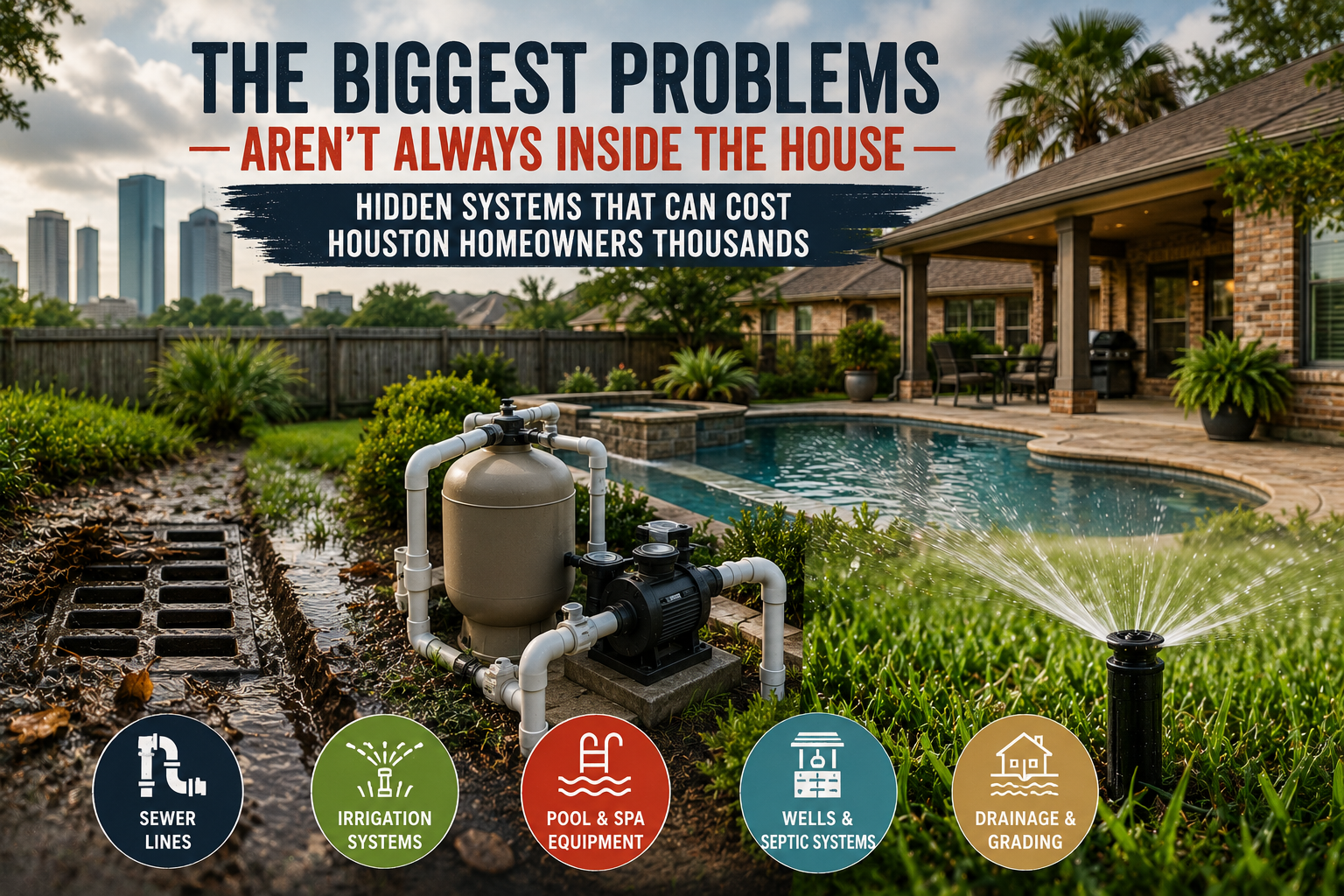
When most people think about a home inspection, they picture someone checking the roof, attic, electrical panel, HVAC system, and foundation. Those are critical parts of every inspection, but in the Greater Houston area, some of the biggest risks aren’t found inside the home at all.
They’re often hidden beneath saturated soil, tucked behind the backyard fence, or buried under years of Gulf Coast weather.
From established neighborhoods inside Beltway 8 to newer communities stretching toward Katy, Cypress, Fulshear, Pearland, League City, and Montgomery County, every part of the Houston region presents its own challenges. Understanding those differences can help buyers make smarter decisions before closing.
Water Is Part of Life Along the Gulf Coast
One thing nearly every Houston-area homeowner learns is that water shapes everything.
Heavy rain events, tropical systems, high humidity, and low-lying terrain all influence how homes and properties perform over time.
That’s one reason drainage deserves as much attention as the house itself.
Standing water, poor grading, clogged drainage paths, improperly functioning irrigation systems, and moisture around the foundation can all contribute to problems that become more expensive over time. While a standard home inspection evaluates visible grading and drainage conditions, additional inspections may be appropriate depending on the property’s features.
For homes with extensive landscaping or larger lots, irrigation systems should also be evaluated to ensure they are operating properly rather than masking drainage problems or wasting water through hidden leaks.
Mature Neighborhoods Can Have Hidden Infrastructure
Some of Houston’s most desirable neighborhoods were built decades ago.
Areas such as Memorial, Spring Branch, Meyerland, Bellaire, West University, Clear Lake, and countless established communities throughout Harris County attract buyers because of their mature trees, larger lots, and established character.
Those same mature landscapes often mean aging underground infrastructure.
Tree roots naturally seek moisture, making older sewer lines particularly vulnerable over time. A sewer scope can identify root intrusion, broken sections, offsets, and other hidden conditions that simply aren’t visible during a traditional walkthrough.
Because sewer repairs can involve excavation, discovering these issues before closing can save buyers significant expense later.
Acreage Brings Freedom—and More Responsibility
As buyers move farther from the city toward places like Waller County, Montgomery County, Liberty County, or Brazoria County, many begin looking for larger properties with workshops, barns, detached garages, or additional acreage.
Those properties often rely on systems that suburban buyers have never owned before.
Private wells, septic systems, multiple electrical services, irrigation covering several acres, and detached structures all become part of the purchase.
Each of those systems should be evaluated on its own merits rather than assuming everything outside the main home is in good condition.
Backyard Living Doesn’t Stop When Summer Starts
Houston homeowners use their outdoor spaces for much more of the year than many parts of the country.
Pools, spas, outdoor kitchens, covered patios, and entertainment spaces aren’t luxury features for many families—they’re part of everyday living.
Those amenities also contain pumps, heaters, plumbing, electrical components, safety devices, and filtration systems that deserve their own inspection.
Likewise, irrigation systems often work nearly year-round in Southeast Texas. Small leaks or malfunctioning zones may not be obvious during a showing but can waste substantial amounts of water over time while contributing to overly saturated soil around portions of the property.
The Climate Creates Different Risks
Unlike many parts of Texas, Houston’s combination of warmth and humidity creates conditions where moisture-related issues deserve careful attention.
Depending on the property, additional services such as infrared imaging can help identify temperature differences or moisture concerns that may not be readily visible. Licensed termite inspections are also especially valuable because wood-destroying insects remain active throughout much of the year in Southeast Texas.
Gas leak testing and appliance recall monitoring can provide additional peace of mind depending on the home’s age and systems.
Every Houston Home Has Its Own Story
A townhome inside the Loop has different priorities than a waterfront property near Clear Lake. A home in a master-planned community in Cypress has different considerations than an older ranch home in Spring Branch. An acreage property outside Magnolia presents different inspection needs than a suburban home in Sugar Land.
That’s why there isn’t one inspection package that’s right for every property.
The best inspection strategy considers how the home was built, where it’s located, the systems it relies on, and how those systems are affected by Southeast Texas conditions.
When buyers understand the property as a whole—not just the house—they’re better equipped to make confident decisions before closing.
And when those inspections can be coordinated through one experienced inspection company, the process becomes simpler, more efficient, and far less stressful. That’s part of Semper Fi Home Inspections’ commitment to being your One-Stop Home Inspection Solution and helping Houston-area buyers protect one of their biggest investments.
For a professional home or commercial inspection in the Dallas/Fort Worth Metroplex or Greater Houston Metro Area that will provide you peace of mind, schedule your inspection now
Call
682-351-2267
or book online